Right now, there may be a 25-year-old in New York thinking he wants a new phone. He sees one mentioned in a social media reel. He opens an AI chat interface and asks which configurations are worth the price. Then, he checks content platforms for reviews about the brand and model. He hasn’t even typed anything into a search bar yet, but he already knows what he’s buying.
That’s not one user. That’s millions of Gen Z consumers globally. In the US alone — 71 million (Visual Capitalist). And they’re just getting started.
Why Gen Z is the audience you can’t afford to get wrong
Millennials still hold the bigger wallet.
But Gen Z is the only generation whose spending is rapidly accelerating. By 2030, this generation is projected to contribute more high-net-worth individuals to every region globally than any prior generation, retiring the “broke generation” myth for good.
By 2034, Gen Z will add almost $9 trillion USD in spending globally — more than any other generation.
Growth 2024–2030
+$2.8T
Percent change
+28.6%
Avg annual growth
+4.3%
Now that we know how much they’re projected to spend, it’s crucial to decode the decision-making. Gen Z doesn’t shop the way Millennials do, and those habits are already bleeding into older age groups. Brands built entirely around Millennial-era search behaviour aren’t just missing Gen Z but also falling behind the curve for everyone.
Here’s a deep dive into key behavioural patterns.
Gen Z’s path to purchase is not linear.
First things first: Gen Z hasn’t abandoned traditional search. But they treat it very differently from Millennials.
Millennials adopted social platforms as a complement to traditional search. Gen Z treats them as equals, with each one serving a different stage and purpose.
18–24-year-olds issue more daily queries than any other age group (Google internal data). But a YPulse survey of US consumers found only 46% start their search journey there, unlike millennials who still begin with a search engine.
Gen Z is matching platform to intent. Alternate surfaces such as social media, niche browsers, BNPL apps, AI interfaces, etc. for discovery and research. Traditional search, for an added layer or transactional confirmation.
This also tracks with what came up at Affinity Conversations, our Women’s Day 2026 panel in India. A session on Gen Z women drew one of the sharpest debates of the night highlighting how this generation researches everything, trusts nothing at face value, and spends only when they’re convinced.
Put plainly: for most of their searches, the search bar isn’t the first touchpoint. Or the most important one. It’s a later-stage tool. In some cases, it’s not there at all.
They use AI as a research and shopping assistant.
Gen Z uses AI tools to ideate — “what should I try?”, “what works for someone like me?” — while Millennials use them to verify and compare. Same tool, different job.
Additionally, 61% of US Gen Z use AI tools during the shopping journey — the highest rate of any generation (PayPal).
The trust dynamic is striking, too. A study of US consumers (including 18-28-year-olds) found 61% trust GenAI over traditional search (eMarketer).
% of US regular genAI users, on whether they trust genAI over organic search results
Hover a slice to focus.
7.6%
Trust less
31.3%
Trust the same
61.1%
Trust more
For paid marketers, it creates a reach gap that didn’t exist a few years ago: a brand not surfaced within AI interfaces is absent from a growing portion of Gen Z’s research.
They prefer zero clicks over fewer clicks.
60% of searches on traditional engines end without a single click to an external website.
AI Overviews now appear on nearly 20% of US desktop searches (Semrush). For the informational queries Gen Z runs before converting, that share is higher.
Gen Z’s preference for fast, consolidated answers makes them the demographic most likely to get what they need and move on without clicking anything. If click volume is your primary performance signal, you’re measuring as well as optimizing the wrong thing for this audience.
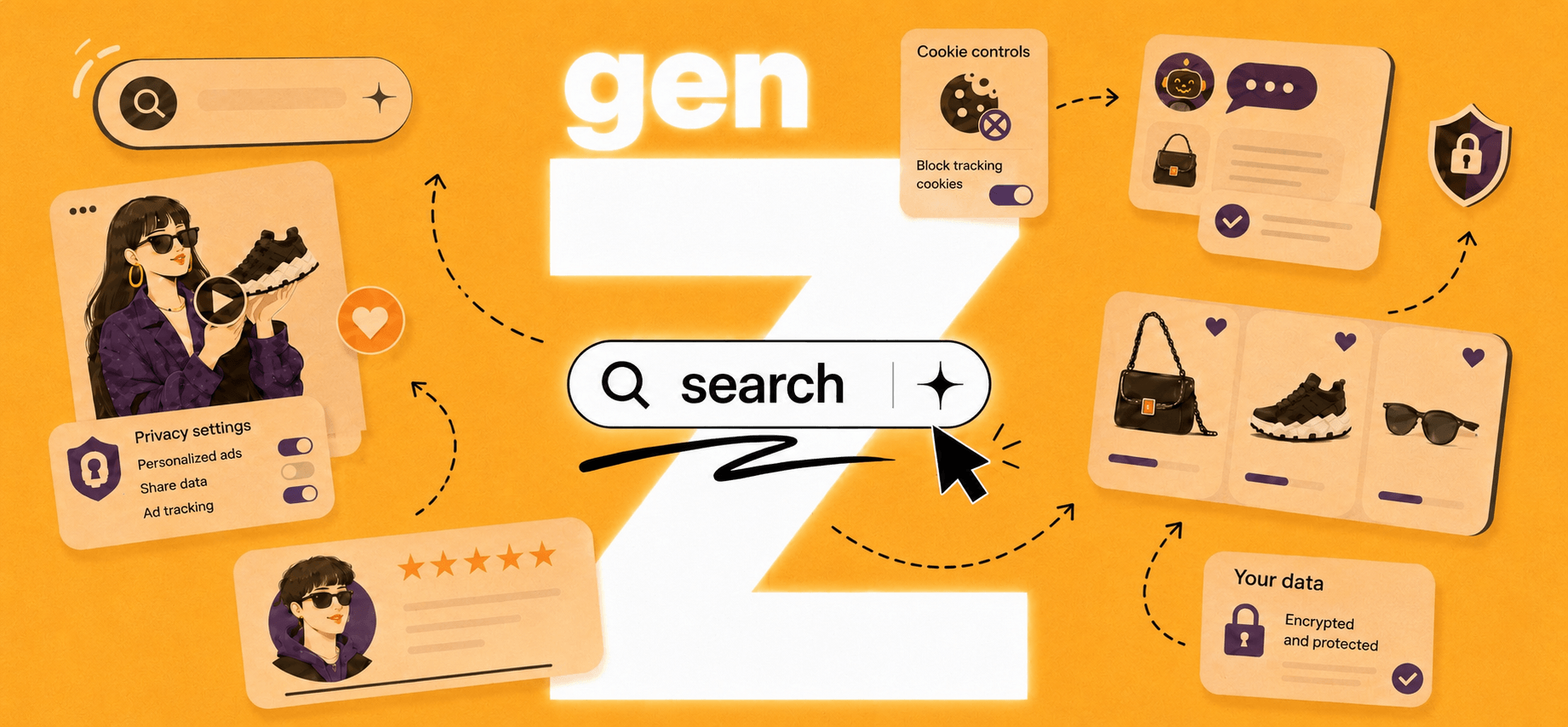
Gen-Z is becoming increasingly privacy-conscious.
Data privacy importance: 42 percent of Gen Zers compared to Millennials.
42% of Gen Zers said that data privacy is “very important to them,” compared to Millennials.
Source: The Atlantic
0%
Gen Zers
Privacy-focused browsers are no longer niche. Brave holds 3.13% of the US desktop market as of early 2026, Firefox another 3–3.64%, and DuckDuckGo continues to grow on mobile. A meaningful share of US browsing is already happening in environments built to block conventional ad tracking, and Gen Z is the fastest-growing segment driving that shift.
This is the first generation that never knew a world without the internet. They watched data get harvested, ads follow them across platforms, and the rules change without warning. Privacy is their baseline expectation.
That makes these browsers an untapped reach surface. Cookie-dependent retargeting gets less effective every year against an audience that is deliberately moving to surfaces designed to filter it out.
How Marketers Can Reach Gen Z
1. Show up where they’re actually searching.
Gen Z doesn't follow a single path to purchase. They discover on alternate platforms, research through AI, and declare intent in ways that may never involve a typed query. A strategy built around one surface catches one stage. The brands that win this audience are present at all three — pre-search, during search, and post search.
2. Get visible inside AI interfaces and answers.
Gen Z trusts AI-generated answers more than traditional search results. Test ad placements that boost brand visibility inside these environments.
3. Start investing in Gen Z now, not later.
The spending gap between Gen Z and Millennials is closing fast, and Gen Z's habits are already shaping how older cohorts discover and buy. Don't wait until Gen Z "matures" into the primary audience; treat them as the primary audience right now.
Gen Z spending on discretionary items grew 25.5% year-over-year in 2025 — higher than any other cohort.
Credit and debit card spending by category for Gen Z and overall population in February (six-month moving average, YoY%).
If you’re wondering how to get started, SitePlug’s Omni Search is your entry point.
Rather than optimizing for one stage of the journey, it extends your reach across the surfaces Gen Z uses, including the ones where your current strategy has no presence at all.
Know how it works and rethink your approach to paid search.
Get in touch!